Followers

Showing posts with label Anglo-Saxons. Show all posts

Monday, 27 April 2020

St Edmund the Martyr


20th November is the saint’s day of Edmund the Martyr, the only English monarch to be declared a Christian martyr until King Charles I in 1649.

According to the traditional account (which has been disputed) Edmund was only 14 in 855 when he was declared king by the leading men and clergy of Norfolk, who were soon joined by those of Suffolk, thus making Edmund the undisputed king of East Anglia (the Angles had accompanied the Saxons in their invasion of England after the withdrawal of the Romans).

Edmund proved to be devout as a Christian and a just ruler, modelling himself on King David of the Old Testament.

However, after only ten years of peaceful rule, a major threat arrived in the shape of the Danish “Great Heathen Army” that landed in Suffolk in 865 and proceeded to sweep northwards, taking York in 866. They then moved southwards again, arriving in East Anglia in 869.

Edmund was killed in the battle that ensued, after which the Danes overran East Anglia, which would become part of the “Danelaw” that later kings of England were forced to recognise as being beyond their power to control.

St Edmund came to be venerated after his death, including by the Danes who overthrew him. Coins have been discovered that circulated in the Danelaw and bear Edmund’s image.

Edmund’s remains were eventually buried in a shrine at what was originally called St Edmundsbury but is now more usually known as Bury St Edmunds. (The comic writer Clement Freud once named a racehorse “Dig Up St Edmunds”, but that’s another story!)

The shrine of St Edmund came to be a place of pilgrimage that was visited for several centuries, bringing considerable wealth to Bury St Edmunds Abbey. However, the shrine was destroyed in 1539 as part of the Dissolution of the Monasteries under King Henry VIII.

© John Welford

Saturday, 8 September 2018

Wihtgar, King of Wight: myth or reality?


The Isle of Wight lies off the south coast of England, separated from Hampshire by two narrow waterways, namely The Solent and Spithead. It might be thought that its name derives from a corruption of “white”, with a reference to the white cliffs that culminate in the Needles rocks at its western end, but this is not so. 

Tradition maintains that “Wight” comes from “Wihtgar”, who was a shadowy – probably legendary - figure from the early history of England.

The Anglo-Saxon Chronicle says that two warriors, Stuf and Wihtgar, fought against the British in the year 514 and were later given lordship over the Isle of Wight by Cerdic and Cynric (Kings of Wessex), to whom they were related. Wihtgar is said to have died in 544 but to have founded a dynasty that ruled the island until 685. One of his descendants was reputed to have been Osburh, the mother of King Alfred the Great. 

But can the Anglo-Saxon Chronicle be believed? Although the name Stuf is acceptable as a personal name, there are problems with “Wihtgar”. “Wiht” is an Anglicised form of Vecta, which was the Latin name for the Isle of Wight going back to Roman times, and the later inhabitants of the island were often referred to as “Wihtgara”.

The Venerable Bede, who wrote his “Ecclesiastical History of the English People” in around the year 730, held that Kent and the Isle of Wight were settled by people known as Jutes, a Germanic tribe who arrived in Britain alongside the Angles and the Saxons in the late 4th century. Doubts have been cast by later historians over whether the Jutes ever existed as a separate people, but there certainly appear to have been links between the settlers of Kent and the Isle of Wight. One such link is that several royal personages in Kent had names that began with “Wiht-“.  The suggestion is therefore that the name Wihtgar derives from Wiht and Wihtgara and not the other way round.

The connection between Wihtgar, Cerdic and Cynric also appears to have been made much later than the early 6th century, the first mentions of such a link being from around the time that the last King of Wight, Arauld, was killed after the island was overrun in 685 by the West Saxon King Cædwalla. 

It therefore appears that King Wihtgar may never have existed at all but to have been an invention of the early chroniclers who sought an origin for a name, which was something that is known to have happened in other cases.

© John Welford

Wednesday, 14 September 2016

Aethelbald, the king of Wessex who married his step-mother


Scandals in high places are nothing new. This is King Aethelbald of Wessex (western and southern England), who shocked 9th century society by marrying his step-mother.

Aethelbald was the eldest of the four sons of King Aethelwulf (reigned 839 to 858) – the youngest son is much better known to history because he would later become King Alfred the Great. Aethelwulf’s first wife, and the mother of all his sons, was Osburh. However, when Osburh died (probably in the year 854) Aethelwulf took a new bride, a European princess named Judith.

Aethelwulf died in 858, to be succeeded by Aethelbald, who promptly married Judith.

Alfred’s friend and later biographer, Asser, wrote that this was ‘contrary to God’s prohibition and Christian dignity’. Given that Aethelbald had also mounted a revolt against his father two years previously, this act of incest (as it would have been interpreted at the time) did not go down well with the people of Wessex, and there was general relief when he died only two years later.

The throne then passed down the line of the other brothers, ending with Alfred who brought a much-needed restoration of power and dignity to the affairs of England’s most powerful kingdom.


© John Welford

Monday, 7 March 2016

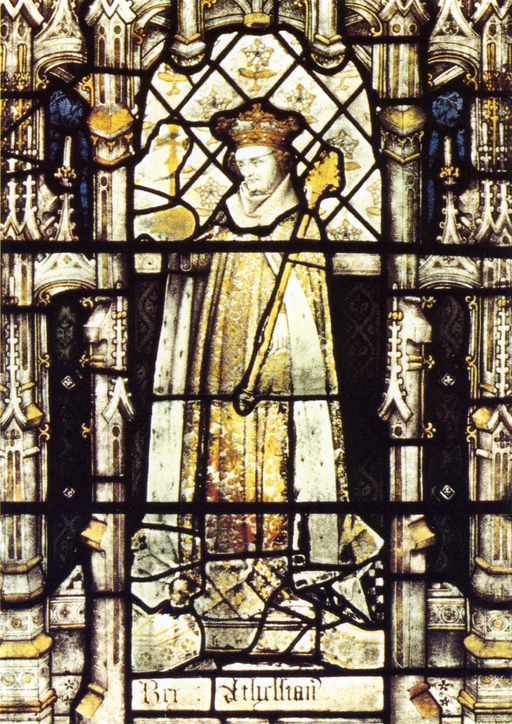
Athelstan, first king of a united England


King Alfred of Wessex, who died in 899, is the only English king to whom is accorded the title “Great”, but perhaps his grandson Athelstan was equally deserving of that honour, given that that he was the first king of what is recognisable as modern England.


Athelstan’s early life

Athelstan was the son of Edward the Elder, who ruled Wessex from 899 until his death in 924. Athelstan was born in about the year 894 (this is uncertain) and he was regarded from an early age as a potential king.

It has to be remembered that the Anglo-Saxon monarchies did not adopt the custom of primogeniture that is typical of most modern monarchies. Kings were elected to office by the nobility, and simply being the eldest son of a king did not guarantee that one would succeed as the next king.

However, Alfred decided to give his grandson a training in kingship by sending him to the court of his daughter Aethelflaed, who was married to Ethelred, the king of West Mercia, which was in any case a puppet regime under the control of Wessex.

This arrangement paid dividends for Athelstan who was elected king of the Anglo-Saxons in 924 thanks in part to the votes of the Mercian lords who had got used to the idea of Athelstan being “one of them”.


Athelstan as king

Athelstan saw no need to bother with the business of providing an heir, as he had three younger brothers. He also had four sisters who could be married off to supply useful links with the crowned heads of Europe.

A deeply religious man, Athelstan was free to pursue his hobby of collecting religious relics which in turn gave him great credit with the Church. This may in turn have something to do with the generally favourable accounts given of him by contemporary scribes, most of whom would have been churchmen!

One of Athelstan’s sisters, Eadgyth, married King Sihtric of the Kingdom of York which was in the hands of Irish Norsemen at the time. The move for this match came from Sihtric, who was willing to convert to Christianity in order to secure good relations with his southern neighbours. The marriage took place in 926.

Athelstan no doubt saw this marriage as a convenient way of bringing York into his sphere of influence, if not immediately. After all, the kingdoms of Wessex and Mercia had been united as the result of a marriage, so why should the same not apply in the case of York?


Forced to fight

However, things did not work as smoothly as might have been hoped. Sihtric’s move was not popular with his fellow Norsemen, who forced him to renounce his new religion. He was then overthrown and had died within a year of the marriage – possibly murdered.

The leaders in York elected a new king, this being Olaf, the son of Sihtric’s kinsman Guthfrith who promptly arrived from Ireland with an army to support Olaf against any threats from the south.

Athelstan had no choice but to counter this move, and he marched on York.

The campaign was a huge success, with the result that Guthfrith was sent packing northwards into Scotland, where he sought sanctuary, and Olaf was forced to flee to Ireland.


Domination of the north

Athelstan continued northwards to launch an invasion of the Kingdom of Strathclyde, which extended into what is now northern England.

Athelstan summoned the kings of the north to a conference at Eamont, near Penrith (in modern Cumbria). He also summoned King Constantine of Scotland to meet him there and to bring Guthfrith with him. However, Guthfrith managed to escape (possibly with Constantine’s connivance) and made his way back to York.

At Eamont, on 12th July 927, Athelstan received submissions from Constantine, Owain of Gwent and Hywel of Strathclyde, as well as Ealdred who ruled the Northumbrians from his stronghold at Bamburgh. They all recognised Athelstan as sole ruler of the English kingdoms.


Securing the kingdom

Despite the submissions referred to above, Athelstan was far from secure as overlord of England. There was much work still to be done.

In 928 Athelstan once again attacked the Kingdom of York and again found it easy to defeat Guthfrith. However, Athelstan showed clemency to his enemy and allowed him to return to Ireland. Large quantities of treasure were discovered in York, but Athelstan shared the booty between the victorious soldiers.

He then turned his attention westwards and subdued the kings of Wales. He called them to a conference at Hereford, where they were required to agree to pay him large annual tributes.

Another source of trouble was Cornwall, where the “west Welsh” (who were Celts who spoke a language related to Welsh) had infiltrated Devon and settled in Exeter on equal terms with the English. Athelstan drove them out and forced them back across the Tamar.


Athelstan’s government

Athelstan made absolutely sure that the whole of his united kingdom would be treated fairly and according to laws that applied to everyone, whether from Wessex, Mercia or Northumbria, and whether native English, Dane or Norseman.

He established his rule by means of granting charters that made it clear that he saw himself as God’s emissary and that his power to punish breakers of the terms of such charters had divine sanction.

His most important charters were witnessed by all the highest people in the land, including the archbishops of Canterbury and York and representatives of all the nationalities that were now incorporated in his kingdom.

Local administration was devolved to English ealdormen (nobles) in Essex, East Anglia and West Mercia, but to Danish earls in the former Danelaw. All the land, however, was subject to English law.

Athelstan’s laws recognised the equality of all his subjects. These laws sought to crack down on crimes such as theft, perjury and non-observance of the Sabbath.

English towns (the “burghs” founded during Alfred’s reign) flourished under Athelstan’s rule, as he decreed that no trade could be carried out except within their walls, which were required to be maintained. Many market towns of the present day can trace their origin to this period of history.


Keeping the peace

Athelstan still faced challenges to his overlordship of the former English kingdoms, particular those in the north.

In 934 he marched north to face a challenge from King Constantine of Scotland. His army and fleet caused considerable havoc in Scotland, and no doubt he hoped that – by showing who was boss – he would dissuade any other challengers to his authority from flexing their muscles.

However, this proved to be a forlorn hope. In 937 Constantine joined forces with the King of Strathclyde and an expeditionary force of Norsemen from Ireland. Olaf, the former Norse King of York, was anxious to reclaim his throne and saw an alliance with Athelstan’s other northern enemies as his best means of so doing.


The Battle of Brunanburh

According to the Anglo-Saxon Chronicle, the forces joined battle at Brunanburh, although it is not clear exactly where this was. It might have been somewhere in Cumbria, or possibly on the Wirral peninsula where the town of Bromborough is a contender for the battle site. Another candidate is Burnswark Hill in Annandale, southern Scotland.

Athelstan fought alongside his half-brother Edmund and was completely victorious. The battle was commemorated in an epic poem that gave details of the casualties that included “five young kings” and numerous Norse and Scots noblemen.  The main contenders all escaped with their lives, with Olaf having to flee to Dublin yet again.

The battle was the defining moment of Athelstan’s reign in that it showed where the real power lay. However, that dominance was entirely dependent on Athelstan’s skills as a battle commander, because his successors would not find things so easy. Olaf was still waiting in the wings, and was destined for better success after Athelstan’s death.


Athelstan’s legacy

Athelstan died at Gloucester on 27th October 939, at the age of about 45, to be succeeded by his young half-brother Edmund who had fought with him at Brunanburh.

Athelstan’s claim to be the first king of a united England is a strong one, although, as mentioned above, this was not to be a permanent state of affairs given the continuing threats from Danes and Norsemen that would continue for much of the Anglo-Saxon period.

What Athelstan did was to show that it was possible for England to be defended and ruled with justice and efficiency. His successors therefore had a benchmark and a standard to aim for, even if they found it difficult (and sometimes impossible) to follow where Athelstan had led.


© John Welford

Saturday, 6 February 2016

Aethelflaed, the Lady of the Mercians


Women did not have as hard a time in Anglo-Saxon high society as they were to do in later ages. An example of the respect that was shown to high-born women is Aethelflaed, the eldest daughter of King Alfred of Wessex. She was to have a major impact on developments in England, especially after her father’s death in 899.

King Alfred the Great is renowned for having fought off the threat from Danish invaders and turned the tide of what had looked like inevitable defeat. However, Alfred only ruled in Wessex, which was the south and south-west of England. Between his kingdom and the Danelaw (the eastern part of England that was ceded to the Danes) lay the larger kingdom of Mercia. Were Mercia to fall, Wessex would again be threatened.


The Lady Aethelflaed

Alfred left his daughter the large sum of one hundred pounds and a royal estate. She had already been married for several years, her husband being Ethelred of Mercia. The couple proved to be effective joint rulers of Mercia, with Aethelflaed playing an active role in decision-making when it came to defending the kingdom.

Ethelred did not enjoy good health, which placed greater burdens on Aethelflaed; these were increased even further when Ethelred died in 911. Aethelflaed now took over the role of sole ruler, being known as “The Lady of the Mercians”. Although there is no evidence that she took a direct fighting role in any battles against the Danes, she certainly planned campaigns and inspired her troops to greater efforts.

Alfred had been succeeded in Wessex by his son Edward, who joined his sister in campaigning against the Danes. Together they forced the Danes north to the River Humber and freed East Anglia.

Aethelflaed had learned an important lesson from her father, which was to defend territory that had been won by building fortified towns that would act not only as population centres but be places of refuge for farmers in the area should danger threaten. These “burhs” were established throughout Mercia and would form the basis of “boroughs” that exist to the present day. Among them were Tamworth, Warwick, Runcorn and Stafford.

As Aethelflaed’s armies moved north they captured the Dane-held cities of Derby and Leicester and she was on the point of taking York, the Danish capital, when she died in 918.


Aethelflaed’s legacy

Aethelflaed’s doughty spirit was to live on in her nephew, Edward’s son Athelstan. Edward so admired his sister that he sent his son to be brought up by her and gain an apprenticeship in statecraft. The training and example were to pay dividends, in that Athelstan would later unite the kingdoms of England and be entitled to claim the honour of being the first king of all-England.

Aethelflaed’s name is not often brought up in discussions about where the roots of England lie. However, perhaps the Lady of the Mercians deserves to be better remembered as one of the group of remarkable people who saved England from foreign dominance in the 8th/9th centuries.


© John Welford