Followers

Showing posts with label history. Show all posts

Thursday, 6 September 2018

King William IV


Born on 21st August 1765, William was the third son of King George III and would not have expected ever to become King. 

He joined the Royal Navy in 1779 and served in America and the West Indies. He was promoted to Admiral of the Fleet in 1811 and Lord High Admiral in 1827. This service was what gave him the nickname of “Sailor King” during his later reign.

He married Adelaide, daughter of the Duke of Saxe-Meiningen, in 1818, but the two daughters born to the marriage died in infancy. This was in contrast to the nine healthy children that William had previously fathered with an actress, Dorothy Jordan, with whom he had lived between 1790 and 1811.

From 1820 the throne had been in the hands of William’s elder brother George (as King George IV), but his sole legitimate daughter (Charlotte) had died in 1817, leaving him without an heir. 

Next in line should have been Frederick, Duke of York (satirized as ‘The Grand Old Duke of York’), but he died in 1827, also without leaving any legitimate children behind him.

When George died on 26th June 1830, William became King at the age of 64.

The first part of William’s reign was largely given over to the political crisis surrounding electoral reform, which concerned doing away with the medieval and highly undemocratic methods then in force for electing Members of Parliament. 

William was completely opposed to reform, which would have meant a huge diminution of aristocratic privilege and the involvement of the middle classes in the business of government. He used every means at his disposal to frustrate the efforts of reformers, but he could not prevent the election in November 1830 of a Whig government, led by Lord Grey, that was determined to push reform through.

Grey exacted a promise from King William to appoint enough Whig peers to enable his reform bill to pass a vote in the House of Lords, but William later tried to go back on his word and only reluctantly allowed the “Great Reform Bill” of 1832 to become law. 

Although William was not particularly active in the political sphere, he did try, in 1834, to exert influence on who should be Prime Minister. Lord Melbourne had succeeded Grey in July 1834, but William did not like the reforming nature of the Whigs and dismissed Melbourne in November, appointing the Tory Robert Peel in his place, despite the latter’s lack of a Parliamentary majority. Peel’s government soon fell, leading to the return of Lord Melbourne as Prime Minister for the rest of William’s reign. William was the last British monarch to make such an appointment against the will of Parliament.

Despite his innate conservatism and elitism, William was a popular monarch with the British people and was surprisingly informal in many of his personal ways. For example, he was known to issue open invitations for anyone to dine with him, in informal dress, at the Royal Pavilion in Brighton. He also gave half of the royal art collection to the nation and even tried to give away Buckingham Palace, which his predecessor as King had spent a huge sum on restoring.

It is to be noted that William’s short reign included the passing into law of several important social reforms, as well as the Reform Act. These included the Factory Act of 1833, the Slavery Abolition Act of 1833 and the Poor Law Amendment Act of 1834.

© John Welford

Sunday, 19 August 2018

An October birthday for famous people


26th October seems to be a day on which prominent politicians like to get born, particular those with a left-leaning or revolutionary approach to politics.
26th October 1759 was the day on which Georges Jacques Danton (pictured) was born in eastern France. He was an early leading member of the French Revolution of 1789 who voted for the overthrow of the monarchy and the execution of King Louis XVI. He became head of the Committee of Public Safety that condemned thousands of people to death, although he later fell from power and was himself a victim of the guillotine. 
On 26th October 1879 Lev Davidovich Bronstein was born in the Ukraine. He was to lead a parallel life to Danton’s in several respects, notably as a revolutionary leader, regicide, and eventual victim of the monster he helped to create. Under the name Leon Trotsky, he was a leading member of the Bolshevik Party that overthrew the Russian Tsar in November 1917 (although the use of the Julian calendar means that the event is always referred to as the October Revolution). Lenin and Trotsky were almost certainly behind the decision to execute the Tsar and his family in 1918. Trotsky’s fall from power was engineered by his greatest rival, Joseph Stalin, who ordered Trotsky’s assassination after the latter had fled from Russia and was living in Mexico in 1940.
A Socialist of a somewhat different hue was François Mitterand, born on 26th October 1916 in Jarnac, southwest France. He emerged in the 1960s as a left-wing opponent of General de Gaulle and, after several failed attempts against Gaullist candidates, eventually became President of France in 1981. He served two complete 7-year terms and therefore holds the record as France’s longest-serving President. Unlike previous members of the “26th October club” he died peacefully in 1996, from cancer.
The fourth member of the club has very little in common with any of the others, this being Hillary Rodham, born on 26th October 1947 in Chicago, USA. As the wife of Bill Clinton she held the honorary office of “First Lady” from 1993 to 2001, was a senator for New York State (2001-9), and was Secretary of State from 2009 to 2013. Her ambition of becoming the United States’ first woman President came to nothing when she was defeated by Donald Trump in 2016. However, she possesses very few of the Socialist credentials of the erstwhile predecessors who shared her birthday!
© John Welford


Saturday, 10 December 2016

Thomas Hooker


Thomas Hooker was an important figure in the history of colonial America, and not just in Hartford, Connecticut, the city with which he is most closely connected. It is therefore surprising that a school building in a village close to where I live should bear a plaque that declares that the “Reputed Father of American Democracy” was once a pupil there.

Market Bosworth, in Leicestershire, gave its name to the battle in which King Richard III lost his life in 1485, but it was also the seat of the Dixie Family. The Grammar School was founded in 1601 under the will of Sir Wolstan Dixie, and is still running to this day.


Thomas Hooker as a Puritan Clergyman

Thomas Hooker was born in 1586 at Markfield, some ten miles from Market Bosworth.  He was the son of a farmer and would have been one of the first pupils of the new Dixie school, from where he proceeded to Cambridge, taking a BA degree in 1608. He was granted a fellowship, endowed by the Dixie family, and remained at Emmanuel College until 1618.

Emmanuel was a distinctly Puritan college, and Thomas Hooker became a clergyman with a very Puritan outlook, meaning that he believed more in personal spiritual growth than adherence to Church dogma.

Hooker became rector of St George’s, Esher, Surrey. In 1621 he married Susannah Garbrand and they soon had two daughters, both of whom were eventually to become the wives of clergymen in America.

As a puritan, Thomas Hooker objected to the marriage of Prince Charles (later to become King Charles I) to a Catholic Spanish princess, and this marked him out as a potential troublemaker. This reputation grew when he moved to Chelmsford in Essex and he preached many sermons in favour of the nonconformist cause, emphasising individual salvation and castigating the established Church for its oppression and its laxity in spiritual matters. His sermons appealed to a wide swathe of the population, being direct and lively and free of classical allusions. A number of them were published.

He opened a school in Essex, where his family grew further with two more children being born who survived to adulthood. However, his puritan, anti-establishment views were becoming known in high places, and he eventually fell foul of the conformist Bishop of London, William Laud. In 1630 he was summoned to the Bishop’s court but chose to go into hiding, and then exile, rather than fight a case that he knew he could not win.


Thomas Hooker’s Escape to America

In June 1631 Thomas Hooker escaped to the Netherlands, returning only in 1633 to collect his family and take ship for Boston, which they reached on 4th September.

Hooker became the pastor of a church at Newtown (which is now Cambridge, MA), where he found a number of former friends from Essex who had preceded him to the colony. He stayed at Newtown until May 1636, when the decision was made to move further south and west, mainly because of the need to find better grazing land.

The place chosen for the new settlement was known by the natives as Suckiaug, on the banks of the Connecticut River, but was renamed Hartford after the English town of Hertford.


Can Thomas Hooker’s Reputation be Justified?

Thomas Hooker’s reputation as the “Father of American Democracy” comes from his activity during the formation of a colonial confederation of Connecticut towns in 1638. He preached a sermon in which he reminded the citizens that the authority of the leaders of the people depended on the consent of the people to be governed by those leaders. He merely extended to civil society the principle that pertained to church governance within the nonconformist tradition.

The resulting document became known as the “Fundamental Orders” (adopted in January 1639), which set out the conditions under which the Connecticut colony would be run as an entity distinct from that of Massachusetts Bay. It was what might be termed a “proto-Constitution”, in that it contained elements that were to be repeated in later constitutions, and eventually found their way into the Constitution of the United States.

In particular, the Fundamental Orders established the principle of magistrates being elected by secret ballot. It stressed the rights of the individual and set limits on the power of government. The Connecticut colony differed from Massachusetts in that non-members of the church were eligible to stand for office, thus enshrining the principle of the separation of church and state.

The claim that this was the world’s first written constitution was accepted for many years, although modern historians dispute this. It has however led to Connecticut becoming known as the “Constitution State”. Thomas Hooker’s role in this development would seem to have been elevated beyond its rightful place, and to call him the “Father of American Democracy” is somewhat exaggerated. All he did, in reality, was to point out how an Independent church managed its affairs, with the implication that a civic community could do the same.

Thomas Hooker’s role was not in government but in the church. He continued to lead his church in Hartford for the rest of his life, which ended on 7th July 1647. The link between the wall of a school in a Leicestershire market town and the American Constitution is a fascinating one, although the word “reputed” on Thomas Hooker’s blue plaque should not be ignored.

© John Welford

Thursday, 14 April 2016

Queen Mary I


17th November is not a date that is generally celebrated in England but perhaps it should be. In 1558 a hated monarch died and a new age – the Elizabethan Age – was born. The queen who died – Mary the First – was mourned by few.


Queen Mary hardly stood a chance

There are some monarchs who were dealt a bad hand from the start. One of these has to be Queen Mary I, although it was only after she reached the age of 17 that her real problems started.

She had been born on 18th February 1516 to King Henry VIII and Queen Catherine. This was a matter of great joy to her parents, following a series of miscarriages and still births, with the only cloud being the fact that she was a girl rather than a boy.

However, as she got older, and no other children were born, it soon became clear that her father was getting steadily more anxious about the lack of a male heir. The idea that Mary would become a reigning queen was never regarded as a desirable outcome.

From when Mary was aged ten there was little doubt that her father wanted to divorce her mother. Mary felt more comfortable with her mother than her father, and this led to growing friction with King Henry.

When the divorce happened and Henry married Anne Boleyn in 1533, Mary’s world fell apart. Not only was she declared illegitimate and no longer a princess, but her mother was banished from court and Mary was forbidden to have any further contact with her. There were even calls in Parliament that she should be executed.


A dynastic pawn

Mary had no function other than to be a pawn in her father’s power games. Henry could make and break diplomatic arrangements with other crowned heads by having Mary betrothed to whoever he liked, and breaking such engagements as he saw fit. At one time Mary was betrothed to the Holy Roman Emperor, Charles V, who was 15 years older than her, and at another time her intended was 11 years younger, namely Philip II of Spain – who did actually become her husband much later in life.

Another indignity Mary had to face was being forced to defer to her sister Elizabeth, who was born to Anne Boleyn in 1533 and was therefore 17 years younger than Mary. This situation eased after Anne Boleyn was executed in 1536 and Elizabeth was also declared illegitimate. Mary was advised to make her peace with her father and she was accepted back at court.

The birth of her half-brother Edward to Jane Seymour in 1537 did at least seem to settle one thing, namely that Mary could forget about ever becoming queen in her own right, as could Elizabeth. She was, however, restored to her place in the succession after King Henry had entered his sixth and final marriage in 1543.


An uncomfortable subject

Edward became king (as Edward VI) in 1547, at the age of nine, and embarked on a policy of making England a fully Protestant country. Mary had always retained her Catholicism and so was therefore completely at odds with Edward, who demanded obedience from his half-sister who was 21 years his senior. His instructions included that she practice Protestant rites in her worship, which she persistently refused to do.

Mary therefore withdrew from public life to sulk in private over the way the country was going. Although there were serious revolts against King Edward and his “Lord Protectors” there is no convincing evidence that Mary was active in supporting them.


Queen at last

Mary must have assumed – at did everyone else – that Edward would have a long reign and would marry and produce heirs. However, this was not to be. In February 1553 Edward was taken ill – the symptoms suggest tuberculosis – and he never recovered. He died on 6th July at the age of only 15.

Steps had been taken by Edward’s “minders”, but with his consent, to exclude Mary from the succession. As a result, when Edward died he was succeeded by his cousin Lady Jane Grey, who was as much a dynastic pawn as Mary had been earlier in her life. 16-year-old Lady Jane had no wish either to be queen or to be married to the son of the Duke of Northumberland, who was Edward’s chief minister.

As it happened, the unpopularity of Northumberland meant that Jane’s “reign” only lasted for six days. Mary was seen by the people as the rightful successor to Edward, and when she entered London she was received rapturously and the Council of England had no choice but to give way. Mary therefore became queen at the age of 37.

Mary was prepared at first to be merciful to Lady Jane, but the prospect of a revolt in Jane’s favour meant that Mary had little choice but to have her executed the following February.


Bloody Mary

However, now that Mary was queen in her own right, with all the powers of an absolute monarch, she set about – as she saw it – her God-given task of returning England to the true faith.

This meant executing Archbishop Thomas Cranmer and Bishops Ridley and Latimer, who had been active proponents of the English Reformation. They were found guilty of treason and heresy and burned at the stake in Oxford.

However, they were neither the first not the last victims of the “Marian Persecutions”. During Mary’s reign some 300 people, both male and female and of all classes, were executed by burning for refusing to recant their Protestant views. Their stories, many of which were recounted in the “Book of Martyrs” by John Foxe, make harrowing reading. They included a woman in Derby who had been blind from birth, two women in Suffolk whose crime had been to take food to an imprisoned priest, and a woman in the Channel Islands who was heavily pregnant.

The executions began early in 1555 and continued until 15th November 1558, two days before Queen Mary’s own death. Many of the executions were of groups of victims, such as the ten “Sussex Martyrs” who died at Lewes on 22nd June 1557 and several groups of “Canterbury Martyrs”.


Relief at last

Whatever their religious beliefs, there can surely have been few people who did not rejoice that Mary’s reign was shorter than her brother’s. She died from influenza – although it is also possible that she had ovarian cancer – on 17th November 1558 at the age of 42. Her half-sister Elizabeth, who had been living quietly at Hatfield, was immediately welcomed as the new Queen.

With Mary dead, the process of healing could begin, although Elizabeth would create a goodly number of Catholic martyrs during her reign to set alongside the Protestant martyrs of Mary’s.

That said, Elizabeth was greeted as the new Queen with enthusiasm and she would generate genuine love and support from her subjects, which Mary had signally failed to do.


© John Welford

Thursday, 10 March 2016

The legend of Pope Joan


Was there ever a female pope? Many people used to believe that there had been one, and no doubt there are still some today who prefer to accept ancient legends to modern evidence – or the lack of it.


The story of Pope Joan

A monk called Martin wrote in 1265 about a pope called John who was elected in the year 855 and died in 857. However, this apparently male pope turned out to be female when she unexpectedly gave birth when riding through the streets of Rome near the Colosseum. Thus was born the legend of Pope Joan.

Martin may have got this idea from earlier writers, although mentions in sources apparently written before Martin’s time have only survived in manuscripts that were copied later, and are therefore suspect for that reason. The legend is recounted in plenty of other mediaeval sources, but nearly all of them are clearly glosses on Martin’s work and some of them add extra details that are almost certainly inventions by those later writers.

There is one other source that recounts the legend somewhat differently, this having been written by another 13th century monk, namely Jean de Mailly. He talks about the supposed childbirth being followed immediately by Joan’s stoning to death by the shocked populace. The main difference in Jean’s account is that he places it in the early 12th century, although this seems perverse given that the sequence of popes during that period is well established in other sources and there is no gap into which “Pope Joan” could fall.


How the legend could have arisen

What seems to have happened is that an “old wives’ tale” started the rounds during a poorly documented period of Roman history, possibly occasioned by there being a pope who acted in a somewhat effeminate manner. As we all know, stories grow in the telling, especially when somebody writes it down and it gains the status of being on paper “in black and white”.

To add to the confusion, two customs evolved that seemed to confirm the truth of the legend. One was that popes refused to travel along the road in which Joan was supposed to have given birth. This was on the direct route that newly elected popes used to gain access to the church of St John Lateran which is the cathedral church of the city of Rome and where popes are traditionally enthroned as “Bishop of Rome”. A statue of Joan (also called Agnes in some sources) and her son stood at the spot until the late 15th century.

The other custom, which is even stranger, was that newly elected popes had to be physically examined to ensure that they were actually men! This was done during the ceremony in the Lateran when the pope would sit or recline on a special seat that had a hole underneath through which a cardinal would insert a hand to feel the pope’s testicles, afterwards declaring (in Latin) “He has testicles” to which all present would respond “God be praised!”

This idea seems so extraordinary, not to mention revolting, that it is hard to believe. However, two “poping chairs”, made of marble, are known to have existed and one may indeed still do so, although kept well away from public view in the depths of the Vatican. It certainly seems probable that these chairs were used for papal examination for about 400 years, and belief in the legend of Pope Joan seems to be a likely explanation for that use.

However, modern scholarship does seem to have scotched the idea that Pope Joan ever existed. This is partly because of the unlikelihood of the events having taken place as described – could a woman in such a prominent public office really have concealed her sex for a matter of years, not to mention a pregnancy carried to full term? However, the most convincing evidence comes from the fact that the original dating for Joan’s “reign” was impossible, given that coins from the period make it clear that there was no gap between the preceding and succeeding popes into which Pope Joan would fit.

Much as one might like to believe the legend, a legend it must remain!


© John Welford

Monday, 7 March 2016

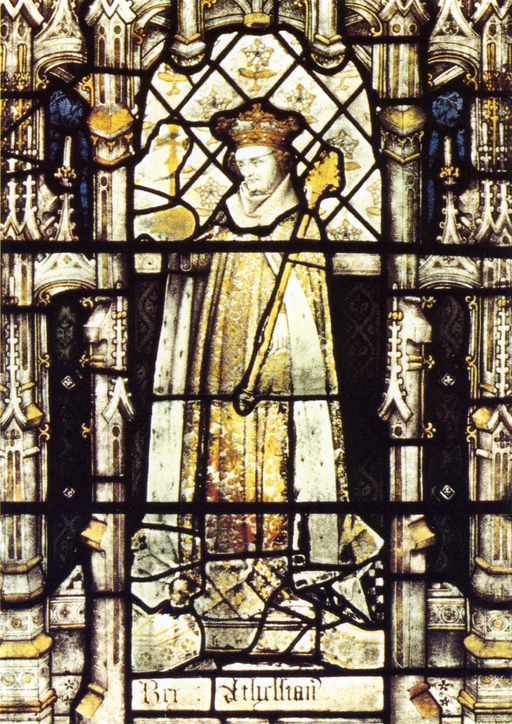
Athelstan, first king of a united England


King Alfred of Wessex, who died in 899, is the only English king to whom is accorded the title “Great”, but perhaps his grandson Athelstan was equally deserving of that honour, given that that he was the first king of what is recognisable as modern England.


Athelstan’s early life

Athelstan was the son of Edward the Elder, who ruled Wessex from 899 until his death in 924. Athelstan was born in about the year 894 (this is uncertain) and he was regarded from an early age as a potential king.

It has to be remembered that the Anglo-Saxon monarchies did not adopt the custom of primogeniture that is typical of most modern monarchies. Kings were elected to office by the nobility, and simply being the eldest son of a king did not guarantee that one would succeed as the next king.

However, Alfred decided to give his grandson a training in kingship by sending him to the court of his daughter Aethelflaed, who was married to Ethelred, the king of West Mercia, which was in any case a puppet regime under the control of Wessex.

This arrangement paid dividends for Athelstan who was elected king of the Anglo-Saxons in 924 thanks in part to the votes of the Mercian lords who had got used to the idea of Athelstan being “one of them”.


Athelstan as king

Athelstan saw no need to bother with the business of providing an heir, as he had three younger brothers. He also had four sisters who could be married off to supply useful links with the crowned heads of Europe.

A deeply religious man, Athelstan was free to pursue his hobby of collecting religious relics which in turn gave him great credit with the Church. This may in turn have something to do with the generally favourable accounts given of him by contemporary scribes, most of whom would have been churchmen!

One of Athelstan’s sisters, Eadgyth, married King Sihtric of the Kingdom of York which was in the hands of Irish Norsemen at the time. The move for this match came from Sihtric, who was willing to convert to Christianity in order to secure good relations with his southern neighbours. The marriage took place in 926.

Athelstan no doubt saw this marriage as a convenient way of bringing York into his sphere of influence, if not immediately. After all, the kingdoms of Wessex and Mercia had been united as the result of a marriage, so why should the same not apply in the case of York?


Forced to fight

However, things did not work as smoothly as might have been hoped. Sihtric’s move was not popular with his fellow Norsemen, who forced him to renounce his new religion. He was then overthrown and had died within a year of the marriage – possibly murdered.

The leaders in York elected a new king, this being Olaf, the son of Sihtric’s kinsman Guthfrith who promptly arrived from Ireland with an army to support Olaf against any threats from the south.

Athelstan had no choice but to counter this move, and he marched on York.

The campaign was a huge success, with the result that Guthfrith was sent packing northwards into Scotland, where he sought sanctuary, and Olaf was forced to flee to Ireland.


Domination of the north

Athelstan continued northwards to launch an invasion of the Kingdom of Strathclyde, which extended into what is now northern England.

Athelstan summoned the kings of the north to a conference at Eamont, near Penrith (in modern Cumbria). He also summoned King Constantine of Scotland to meet him there and to bring Guthfrith with him. However, Guthfrith managed to escape (possibly with Constantine’s connivance) and made his way back to York.

At Eamont, on 12th July 927, Athelstan received submissions from Constantine, Owain of Gwent and Hywel of Strathclyde, as well as Ealdred who ruled the Northumbrians from his stronghold at Bamburgh. They all recognised Athelstan as sole ruler of the English kingdoms.


Securing the kingdom

Despite the submissions referred to above, Athelstan was far from secure as overlord of England. There was much work still to be done.

In 928 Athelstan once again attacked the Kingdom of York and again found it easy to defeat Guthfrith. However, Athelstan showed clemency to his enemy and allowed him to return to Ireland. Large quantities of treasure were discovered in York, but Athelstan shared the booty between the victorious soldiers.

He then turned his attention westwards and subdued the kings of Wales. He called them to a conference at Hereford, where they were required to agree to pay him large annual tributes.

Another source of trouble was Cornwall, where the “west Welsh” (who were Celts who spoke a language related to Welsh) had infiltrated Devon and settled in Exeter on equal terms with the English. Athelstan drove them out and forced them back across the Tamar.


Athelstan’s government

Athelstan made absolutely sure that the whole of his united kingdom would be treated fairly and according to laws that applied to everyone, whether from Wessex, Mercia or Northumbria, and whether native English, Dane or Norseman.

He established his rule by means of granting charters that made it clear that he saw himself as God’s emissary and that his power to punish breakers of the terms of such charters had divine sanction.

His most important charters were witnessed by all the highest people in the land, including the archbishops of Canterbury and York and representatives of all the nationalities that were now incorporated in his kingdom.

Local administration was devolved to English ealdormen (nobles) in Essex, East Anglia and West Mercia, but to Danish earls in the former Danelaw. All the land, however, was subject to English law.

Athelstan’s laws recognised the equality of all his subjects. These laws sought to crack down on crimes such as theft, perjury and non-observance of the Sabbath.

English towns (the “burghs” founded during Alfred’s reign) flourished under Athelstan’s rule, as he decreed that no trade could be carried out except within their walls, which were required to be maintained. Many market towns of the present day can trace their origin to this period of history.


Keeping the peace

Athelstan still faced challenges to his overlordship of the former English kingdoms, particular those in the north.

In 934 he marched north to face a challenge from King Constantine of Scotland. His army and fleet caused considerable havoc in Scotland, and no doubt he hoped that – by showing who was boss – he would dissuade any other challengers to his authority from flexing their muscles.

However, this proved to be a forlorn hope. In 937 Constantine joined forces with the King of Strathclyde and an expeditionary force of Norsemen from Ireland. Olaf, the former Norse King of York, was anxious to reclaim his throne and saw an alliance with Athelstan’s other northern enemies as his best means of so doing.


The Battle of Brunanburh

According to the Anglo-Saxon Chronicle, the forces joined battle at Brunanburh, although it is not clear exactly where this was. It might have been somewhere in Cumbria, or possibly on the Wirral peninsula where the town of Bromborough is a contender for the battle site. Another candidate is Burnswark Hill in Annandale, southern Scotland.

Athelstan fought alongside his half-brother Edmund and was completely victorious. The battle was commemorated in an epic poem that gave details of the casualties that included “five young kings” and numerous Norse and Scots noblemen.  The main contenders all escaped with their lives, with Olaf having to flee to Dublin yet again.

The battle was the defining moment of Athelstan’s reign in that it showed where the real power lay. However, that dominance was entirely dependent on Athelstan’s skills as a battle commander, because his successors would not find things so easy. Olaf was still waiting in the wings, and was destined for better success after Athelstan’s death.


Athelstan’s legacy

Athelstan died at Gloucester on 27th October 939, at the age of about 45, to be succeeded by his young half-brother Edmund who had fought with him at Brunanburh.

Athelstan’s claim to be the first king of a united England is a strong one, although, as mentioned above, this was not to be a permanent state of affairs given the continuing threats from Danes and Norsemen that would continue for much of the Anglo-Saxon period.

What Athelstan did was to show that it was possible for England to be defended and ruled with justice and efficiency. His successors therefore had a benchmark and a standard to aim for, even if they found it difficult (and sometimes impossible) to follow where Athelstan had led.


© John Welford

Tuesday, 2 February 2016

Subutai, a ruthless "dog of war"


Although there can be few people who have not heard of Genghis Khan, the Mongol emperor who swept all before him as he built a vast Asian empire in the 13th century, the same cannot be said of Subutai, who was one of the Khan’s feared “dogs of war”. However, without Subutai’s leadership and tactical genius it is quite possible that Genghis Khan would have achieved very little. The story of Subutai, who was arguably one of the greatest generals of all time, therefore deserves to be better known.


The rise of Subutai

Subutai was not a Mongol by birth but a member of the Uriangkhai tribe from the shores of Lake Baikal in central Asia. He was the second son, born in 1175, of a blacksmith whose work took often him south to provide services to the nomadic Mongols at one of their temporary camps. Subutai’s father probably met Temujin (born 1162), who was to become Genghis Khan (a title meaning “great lord”) on one of these trips. At some stage Temujin offered to take on the blacksmith’s two sons as servants.

Subutai had to learn the way of life of the Mongol warrior, which was centred around the horse, not only as a means of waging war but as a source of food in the form of mare’s milk, which was fermented and mixed with blood. Mongol armies could cover huge distances because they never stopped moving all day. A soldier would pack raw meat under his saddle where it would be tenderised as he rode; he would cut off and eat strips of it as he rode along.

Subutai rose to become a trusted lieutenant to Tamujin. When the latter suffered defeat at the hands of his rival Jamuka in 1203, Subutai stayed loyal and helped him to exact his revenge a year later.

In 1205 Subutai was given his first solo command, which was to track down and destroy bands of the Merkit tribe who had escaped an attack by Temujin. This attack had been made possible by Subutai’s cunning, as he had gone to their camp and pretended to be a traitor to Temujin. Having persuaded them that Temujin would not attack they relaxed their guard, at which point Temujin did indeed attack.

In 1206 Temujin assumed the title of Genghis Khan and appointed his four “orloks”, or field marshals, with Subutai being one of them.


Conquest in the east

In 1210 Subutai played a vital part in the defeat of the Jin dynasty of northern China, which was protected by the Great Wall and whose population vastly outnumbered that of the Mongols. With an army of 30,000 mounted soldiers, Subutai moved south across the Gobi Desert and attacked the wall. This forced the Chinese to focus their attention to the north but it was a diversionary tactic; Genghis Khan’s main army of 90,000 men then attacked from the west and the Chinese had to turn to meet this much greater challenge.

The battle was hard fought, but Subutai’s men were able to catch up and attack the Chinese in the flank, which proved to be decisive. The Chinese capital of Zhongdu (the site of modern Beijing) was overrun and most of its people killed, but it would not be until 1234 that the Jin dynasty finally gave in.


Heading westwards

Meanwhile the Mongols looked westwards for their next conquest, with their eyes on the vast Muslim empire of Khwarezm to the south and east of the Caspian Sea (covering much of modern-day Turkmenistan, Uzbekistan, Afghanistan and Iran). The empire was governed by Shah Ala ad-Din Muhammad.

Subutai and his fellow “dog” Jebe were sent at the head of an army of 200,000 men, which was only half the size of the potential force they would confront. Subutai sent Jebe to lead a 30,000 strong diversionary force through a high mountain pass while taking the main force across the vast Kyzylkum desert to attack the capital city of Samarkand from the west. Shah Ala was forced to retreat.

Genghis Khan’s army proceeded to work its way through the Khwarezm empire, destroying every city it came across and killing millions of people. The Mongol tactic was always to pursue a defeated enemy and to use terror as a weapon that would discourage anyone from offering resistance. Eventually the Shah escaped with a few bodyguards to an island in the Caspian Sea, where he died. Genghis Khan then returned to Mongolia.

However, Subutai was far from finished with the business of conquest. In February 1221 he headed north and west towards Russia with 20,000 men and was met in Georgia by King George the Brilliant. The Mongols used to great effect the tactic of feigning retreat and then counter-attacking, forcing the Georgians to retreat to their fortified capital of Tiflis. However, on this occasion the Mongols did not attack their weakened enemy but retreated themselves, being short of supplies.

Instead, they returned when least expected, late in the year when armies would not normally be on the march. The Georgians were taken completely by surprise and routed, with King George being killed. Subutai’s army was then free to continue northwards through the Caucasus Mountains.

However, it was now Subutai’s turn to be taken unawares. Emerging from a mountain pass, he found that there was an opposing army waiting to do battle with him. This was a coalition force comprising remnants of the Georgian army and members of the Cuman tribe who were related to the victims of Genghis Khan’s Khwarezm campaign.

Subutai was never one to fight a battle that he knew he could not win, so he adopted the tactic of “divide and conquer” by bribing the Muslim Cumans to abandon the Christian Georgians. With the Cumans out of the way, the Georgians were easily defeated but, once this was achieved, Subutai chased after the Cumans and slaughtered them too.

A meeting with a band of traders from Venice allowed Subutai to strike a deal by which his agents gained valuable intelligence about the peoples of western Europe that might be on a future conquest list, in exchange for a promise to destroy the trading posts of nations that were in competition with Venice.

Subutai had one more stunning victory, against the 80,000 strong army of the Prince of Kiev in 1222, before heading for home. However, he would return in due course.


Back to Europe

Subutai’s next venture westwards was not until 1237, when he had reached the age of 62. Genghis Khan had died in 1227 and his son and successor Ogodei had mainly been interested in consolidating Mongol power in the far east (against Korea and southern China in particular) before turning his attention to the west.

Subutai, and Ogodei’s son Batu, headed an army of 150,000 men through central Russia, destroying Moscow in 1238 and Kiev in 1240. Central Europe now lay before them, with the army of Hungary, under King Bela IV, being the main obstacle in their path.

Subutai’s tactic was to split his forces by sending 20,000 men north to counter any Polish support for the Hungarians and to face Bela’s force of 70,000 knights with a smaller force of 50,000. They met on the Plain of Mohi in April 1241. 30,000 men were sent in secret to surround the Hungarian flanks while the rest delivered artillery fire in the form of catapults, flaming tar and firecrackers. When the flanking troops closed in, the Hungarians were forced to fight on three fronts, which was a deliberate ploy on Subutai’s part because he had left the fourth side open as a means of escape. When the Hungarians fell for this ruse, the Mongols closed in and proceeded to destroy virtually the entire army.

At this stage, the whole of central and western Europe was at the Mongols’ mercy, but this was when news reached them that Ogodei had died and a new leader must be elected. The Mongols promptly packed up and went home, and this time they did not come back.


An end to conquest

Subutai retired from soldiering and ended his days as a herdsman, far from the centre of power. He died in 1248 aged 73, having in his career conquered 32 nations and won 65 pitched battles, which is more than double the number won by Napoleon Bonaparte.

Subutai’s military tactics have been studied and copied by army leaders down the centuries, particularly as regards his control of smaller units in the field that could be brought together at the opportune moment. Many of the campaign and battle tactics used by modern armies were first developed by this highly successful, and also ruthless, 13th century Mongol commander.


© John Welford

Monday, 1 February 2016

Fletcher Christian, leader of the Bounty Mutiny


Fletcher Christian earned himself a footnote in history as the leader of the Mutiny on the Bounty and also as the “father of his nation”, if the word “nation” is appropriate for the remote and tiny community that continues to this day on Pitcairn Island in the Pacific Ocean.

Early Life

He was born on 25th September 1764 in Cockermouth, Cumberland. He was the seventh of ten children born to a well-to-do merchant and his wife.

After receiving a good education Fletcher Christian enrolled as a midshipman in the Royal Navy in 1783. He sailed to India on board the “Eurydice”, returning in 1785 having been promoted to acting lieutenant.

In 1786-7 he sailed twice to the West Indies under the command of Captain William Bligh. The two men became good friends, and Christian was therefore very willing to serve as master’s mate to Bligh when the latter took charge of HMS Bounty in December 1787 on a voyage to Tahiti to collect breadfruit plants. Bligh was later to remind Christian that they had been on excellent terms at one time and that Christian had played with Bligh’s children while enjoying his hospitality.

The Mutiny

There has been much debate about the causes of the mutiny, depending on whose testimony one chooses to trust. It does, however, appear that William Bligh was inconsistent in his behaviour and lacked “man management” skills. There is some evidence to suggest that Bligh had a habit of blaming others for any setback that was encountered and that he was over-critical of the officers on board, including Fletcher Christian.

When the ship reached Tahiti, Christian allied himself with a group of sailors who had become increasingly dissatisfied with life on board ship. They had been well received by the local Tahitians, especially the women, and a number of them were much keener on staying put than on continuing their voyage.

The mutiny took place on 28th April 1789. Fletcher Christian was in charge of the group of sailors who overpowered Captain Bligh and set him and 18 loyal officers and crew adrift in a ship’s boat.

It is not known whether Fletcher Christian expected Captain Bligh to survive, although he did so only due to a remarkable feat of seamanship and considerable good luck, but the mutineers knew that, whatever Bligh’s fate, they were now criminals who could expect no mercy if they were ever caught.

After the Mutiny

Their first thought was to sail back to Tahiti, where some of the mutineers expected the same welcome they had had before. They looked forward to settling down with Tahitian wives and spending the rest of their lives there.

However, the Tahitian king was horrified at what had happened and had no intention of providing a refuge to the mutineers. He knew full well what his own fate would be if the Royal Navy came looking for HMS Bounty, which was quite likely to happen.

Although some of the mutineers did settle on Tahiti, Christian and the core mutineers, together with their new wives, set sail again in full knowledge that their survival depended on finding somewhere that was so remote that they stood very little chance of ever being found.

That place was the Pitcairn Island group. These four widely spaced islands are more than three hundred miles from anywhere else that is populated (the Gambier Islands) and more than three thousand miles from both New Zealand to the west and South America to the east.

Once the mutineers had settled here they were safe enough from discovery. They arrived in 1790 and did not spot another ship for five years. It was not until 1808 that the islanders would see another human being other than themselves. However, by that time the Pitcairn community was very different from how it had been originally.

One of the first acts of the mutineers, led by Fletcher Christian, was to burn HMS Bounty, thus ensuring that none of them would ever leave the island. With no escape from their new prison – Pitcairn, the only inhabited island, is just over two miles across – they had to create a new society from scratch and find ways to stay alive.

In some ways they were successful, given that there is still a small community of descendants on Pitcairn to this day, but they soon gave way to infighting that led to murder and mayhem. By 1801 only one of the original mutineers, John Adams, was still alive. Fletcher Christian probably died violently in about 1793, but there is no certainty about this.

Assessing Fletcher Christian’s Character

There have been various accounts of Fletcher Christian’s nature and character, some of them being diametrically opposed to others! Some people who knew him described him as a kind, cheerful man, whereas he was also described as being morose and a tyrannical bully. Given the closed and remote location in which he lived his last days it is impossible to know the truth.

One can imagine that, on reflection, Fletcher Christian must have had mixed feelings about how things turned out. Leading the mutiny probably seemed like a good idea at the time, but did he really think through all the consequences? It seems unlikely that he could have done so, unless he actually believed that he could get away with defying the Royal Navy in such a way. If that is so, one has to wonder whether his mental state was all it might have been.


© John Welford

Thursday, 21 January 2016

Napoleon Bonaparte's escape from Elba


On 26th February 1815 Napoleon Bonaparte escaped from his exile on the island of Elba and began his “100 days” revival that would end with final defeat at the Battle of Waterloo.

After a series of defeats, Napoleon had been forced to abdicate on 6th April 1814. The allies sent him to Elba, a small island in the Mediterranean between Corsica and northern Italy. He was allowed to retain the title of Emperor, but his empire now constituted a mere 75 square miles of hills and coastal bays. He could have lived in retirement in some degree of luxury, having been granted a stipend of two million francs a year, but he had other ideas.

He was worried by the rumours he heard that some of his enemies were planning to send him much further afield. Another concern was that he was separated from his wife, Marie-Louise, who he believed was being kept from him by the new rulers in France. However, what he did not know was that Marie-Louise was heartily glad to have parted company with him and was happily involved in a liaison with an Austrian count.

So, on the evening of 26th February, Napoleon gave his captors the slip and, accompanied by some 800 loyal soldiers, left the island in a fleet of sailing boats that landed on the coast of France near Cannes on 1st March.

Gathering supporters as he went, Napoleon marched towards Paris. The recently restored King Louis XVIII fled, and Napoleon was once again the Emperor of France.

After his defeat at Waterloo on 18th June 1815 the allies did not make the same mistake again. This time Napoleon was sent somewhere far less luxurious and much more escape-proof, namely the South Atlantic island of St Helena, where he died in May 1821.


© John Welford

Monday, 18 January 2016

Charles V, Holy Roman Emperor


24th February was an important date in the life of Charles V, the Habsburg Holy Roman Emperor from 1519 to 1546 and ruler over vast swathes of Europe, including Spain, plus Spain’s Latin American colonies.

24th February was the date of his birth in 1500, to the interestingly nicknamed Philip the Handsome and Joanna the Mad. It was from their union that the Spanish provinces were united and became part of the Habsburg Empire under Charles. By the age of 19 he was master of more land in Europe that anyone since the emperors of ancient Rome.

24th February 1525 was not only Charles’s 25th birthday but also the day on which he won a decisive victory at the Battle of Pavia in northern Italy. His opponent was King Francois I of France who was to spend the next year as Charles’s prisoner in Madrid.

Traditionally, Holy Roman Emperors were crowned by the Pope, but Charles delayed this event for more than ten years, to his 30th birthday on 24th February 1530. The event took place in Bologna rather than Rome. For one thing, much of Rome still lay in ruins after Charles had sacked it in May 1527 with considerable savagery and taking of innocent lives; for another, he was worried about the advance of the Ottoman Turks from the east and did not want to travel too far south into Italy.

Charles was crowned by Pope Clement VII, whom he had held prisoner in Rome and forced into exile for a time due to the destruction of the Papal apartments. It was while Clement was in this humiliating situation that he was approached by envoys from King Henry VIII of England to ask for an annulment of his marriage to Catherine of Aragon, who was Emperor Charles’s aunt. Being in no great hurry to antagonise Charles any further, Clement refused, and the end result was the English Reformation.

Charles V’s coronation, conducted by a Pope under severe duress, would prove to be the last such ever held. Although the Holy Roman Empire would continue for nearly another 300 years, its claim to be “holy” really ended with that final coronation on 24th February 1530. Given the previous track record of the emperor it was a mockery of the word in any case.


© John Welford

Saturday, 2 January 2016

Lady Hamilton, mistress of Horatio Nelson


15th January 1815 was the day on which Emma, Lady Hamilton, died in Calais at the age of 50. Hers had been an unfortunate life as a professional mistress, being passed from one aristocratic “owner” to another, and she would have been unknown to history had it not been that one of her partners was Horatio, Lord Nelson, the hero and chief victim of the Battle of Trafalgar.

She started life in 1765 as Emma Lyon, the daughter of a blacksmith. She used her undoubted beauty from an early age and had already borne a child to Sir Harry Featherstonhaugh by the age of 16. She then became the mistress of Charles Greville who subsequently passed her on to his uncle, 62-year-old Sir William Hamilton. She was 21 years old at the time.

The couple married after five years of cohabitation, but Emma had not finished “playing the field”. She was in her thirties when Horatio Nelson came along, and her famed beauty was being compromised as she grew considerably fatter. The Hamiltons and Nelson lived under the same roof for a time, and Emma bore Nelson a daughter.

Sir William died in 1803, but Emma could not marry Nelson because the latter was already married. On Nelson’s death in 1805, Emma was left penniless but petitioned for a government pension on behalf of her daughter, who was Nelson’s only living child.

Emma continued to live above her means but the money gradually ran out and she was eventually forced to live in lodgings in Calais where she spent what money she had on wine. She therefore drank herself to death in poverty, having used her physical attractiveness and lack of morals to rise to the top but having nothing left when her beauty and her lovers left the scene.


© John Welford

Wednesday, 30 December 2015

Huldrych Zwingli, an early Protestant martyr


The name Huldrych Zwingli may not be one of the better known from European history, and it is certainly not one that trips easily off the tongue, but he was an important pioneer of the Protestant Reformation and a contemporary of Martin Luther. 11th October 1531 was the day on which he was killed in a battle between Protestants and Catholics.

Huldrych Zwingli was born in St Gall, Switzerland, on 1st January 1484 and was thus two months younger than Martin Luther. He became a priest at the age of 20 and acted as chaplain to a brigade of mercenary soldiers. In this capacity he fought on the losing side at the Battle of Marignano in September 1515 when the Swiss had been hired to help defend Milan against an attack from France.

As a churchman, Zwingli was anxious to institute reforms in what he saw as a corrupt Church, his basic tenet being that Christ, and not the Pope, was the head of the Church. As a soldier, he adopted a militant attitude to the task of cleaning up the Church, his activities including destroying organs and removing “graven images” from churches and then breaking them up.

Zwingli went further than Luther in that he objected to the doctrine of transubstantiation (the belief that the bread and wine of the Mass were the “real presence” of Christ), and in 1524 he demonstrated his rejection of priestly celibacy by getting married.

He gathered plenty of support for his views, and even incited revolts against such practices as religious fasting. He was particularly successful in the city and canton of Zurich.

In 1531 he set out with his band of soldiers to defend the Protestants of Zurich against the Catholics of five other cantons. At the monastery of Kappel, on the border between the cantons of Zurich and Zug, a fight broke out on 11th October in which Zwingli was fatally injured. His last words were: “What does it matter? They can kill the body but they cannot kill the soul.”


© John Welford